

How long does it take and how much does shipping cost for my country?
Answer
Shipping time and cost may vary according to the shipping method you choose, the total weight of the parcel including packaging, and destination. If you (recipient) receive your order outside Japan, you may be charged custom duty or tariff in some countries and regions. Please kindly understand that all these costs are borne by our customers.
How can I find information about shipping cost and delivery time?
- Go to the English side of Kuroki Goishiten Online Shop. Please select all the items you want to order and click “Choose Shipping Cost” button as shown below.
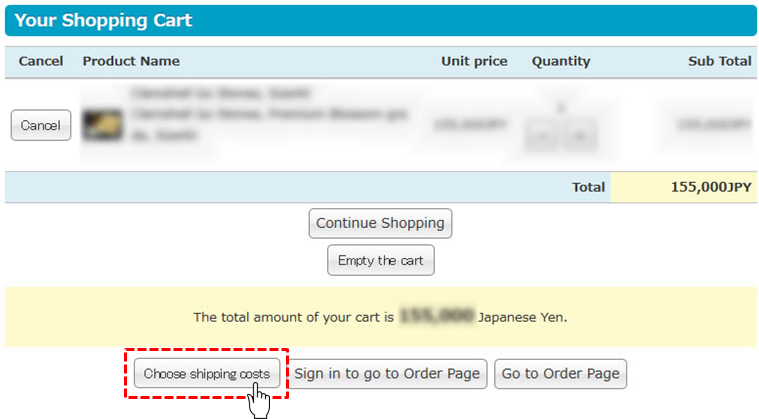
- Please scroll down the bar on the right side of the list and choose the destination.
- Then you will see several shipping methods and costs as shown below.
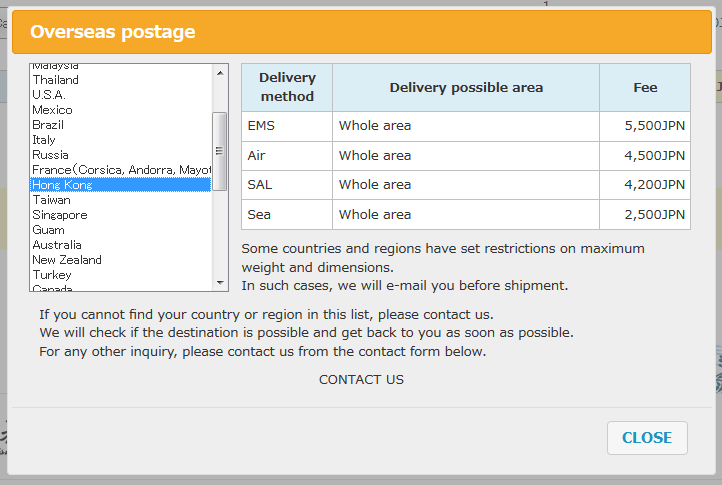
※The shipping cost is calculated based on the method you choose, the total weight of parcel, and the destination. - For any shipment outside Japan, we use Japan Post EMS (Express Mail Service), or AIR (SAL; Economy Air) or SEA. Please choose one of these shipping methods after confirming cost and delivery time.
- Delivery days to the U.S and China are shown in the table below. For other destinations, please go to Japan Post Website.
China EMS (Express Mail Service) 2-3 days AIR 9 days to Shanghai, 8 days to Beijing, 7 days to Hong Kong. SAL (Economy Air) Approx. 2 weeks to Shanghai, Beijing, and Hong Kong. SEA SHIPPING Approx. 1 month to Shanghai and Beijing, 3 weeks to Hong Kong. USA EMS (Express Mail Service) 2-3 days AIR 1 to 2 weeks SAL (Economy Air) Approx. 2 weeks SEA SHIPPING 2 to 3 months ※ Delivery time given above is for your information only. Please note that actual delivery time may vary according to conditions of transportation within Japan, custom clearance, and local transportation in your country or region.
※ For any destination other than the U.S. and China, please contact us or go to Japan Post Website. - Link to the Japan Post website.
How many spare stones are included in a Go stone set?
Answer
Two black and two white stones are included for spare purposes.
180 Clamshell stones (white) + 181 Nachiguro slate stones (black) + 4 spare stones (2 white & 2 black)
What should I do before using Go stones?
Answer
Please wash your hands before using or touching Go stones.
If skin oil comes into contact with the surface of a Go stone and that you do not use it for a long time, its white color could turn yellow.
After playing several Go games with my new board, I found small shallow dents on the surface of the board. Does it happen often?
Answer
Yes, dents often happen because the wooden material of a Go board is softer than Go stones.
Can you give us a certificate of delivery?
Answer
Yes, we always enclose a certificate of delivery with the product(s) your ordered.
Does a set of Go stones include only clamshell (white) stones? Are black stones not included?
Answer
All clamshell stones are paired with slate (black) stones.
Black Go stones are made from the highest quality Nachiguro slate stones that are mined in the deep mountain area of Kumano, Mie Prefecture, Japan.
For your information, Nachiguro slate is used as a touchstone to measure the purity of gold.
If a delivered product is broken or damaged, what should I do? (Including any damages during transportation)
Answer
Please E-mail us or give us a call immediately at +81-982-54-2531.
After sending us an E-mail or giving us a phone call, please send us several photos of the damaged/broken parts by E-mail. We will immediately provide you with our handling procedure.
If the damage was caused during transportation, you will be able to claim compensation from the transportation company. Please keep all the packaging materials and damaged items, which will be required for insurance claim process.
Is it possible to touch Go stones before placing an order?
Question
I would like to order Go stones from Kuroki Goishiten, but I do not know which size is best for me.
Although I read many articles on your website, I cannot imagine what the actual feeling is like.
Is it possible to touch the Go stones before placing an order?
Answer
Yes, we fully understand that most customers want to touch Go stones before placing their order.
We will be happy to send you several sizes of sample stones. Please E-mail us at (customer@kurokigoishi.co.jp) OR call us at +81-982-54-2531 and let us know which sizes or thicknesses you wish to touch.
